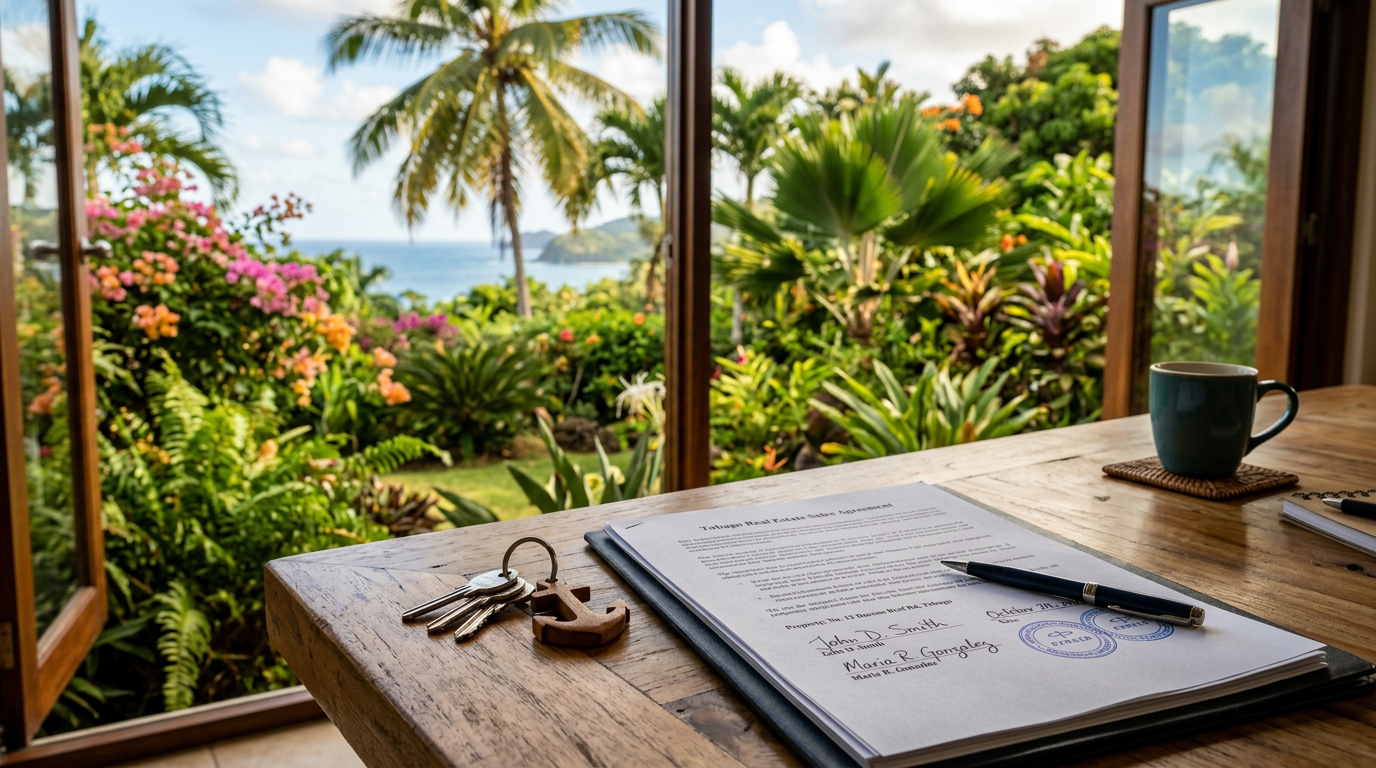
Buying property in a new country can feel daunting. But the Tobago property purchase process, while it has its own legal steps and timeline, is logical and straightforward once you understand each stage. This guide breaks down every step from property search to signing the deed — so you'll know exactly what to expect and what to budget for at each stage.
Quick Navigation
- Before You Start: Pre-Purchase Checklist
- Step 1: Property Search & Shortlist
- Step 2: Make Your Offer
- Step 3: Agreement for Sale & Deposit
- Step 4: Due Diligence & Title Search
- Step 5: Licence to Purchase (Foreign Buyers)
- Step 6: Mortgage Approval (If Financing)
- Step 7: Completion & Transfer of Ownership
- Timeline & Duration
- Costs at Each Stage
- Frequently Asked Questions
Before You Start: Pre-Purchase Checklist
Before you begin looking at properties, take time to prepare. This will make the entire process faster and smoother.
Determine your budget. How much can you comfortably spend on the property itself? Remember to factor in closing costs (5-10% of purchase price). Work backwards from your total available funds to establish a realistic price ceiling.
Get financing pre-approval (if needed). If you're planning to mortgage in Tobago, approach local banks early. For foreign buyers, consider financing through your home-country bank beforehand. Having pre-approval in writing strengthens your offer and speeds up completion.
Identify your needs and priorities. Are you buying for lifestyle, investment, rental income, or a combination? Do you want beachfront or hillside? Urban convenience or rural seclusion? Knowing your priorities helps focus your search.
Choose your real estate agent and attorney. Partner with a local agent who knows Tobago's neighborhoods and market conditions. Engage a local attorney who specializes in conveyancing — they're essential from the first offer through closing.
Step 1: Property Search & Shortlist
This is where the journey begins. You'll browse listings, visit properties, and narrow down your options.
Browse online listings. Check our website and other local portals like Caribbean real estate platforms. Get a sense of what's available, typical prices by area, and feature sets. Online browsing gives you a starting framework.
Visit properties in person. Online photos can deceive. A property that looks perfect online might sit on a noisy road or lack proper drainage. Schedule in-person visits to neighborhoods you're considering. Feel the vibe. Check access roads. Talk to neighbors.
Work with your agent. A good local agent can access off-market properties, negotiate on your behalf, and provide insight into areas you're considering. At Abraham Realty, we arrange comprehensive property tours and give frank advice on areas, pricing, and investment potential.
Create a shortlist. Narrow your options to 3-5 properties that genuinely meet your needs. Don't fall in love with every property — stay objective and strategic.
Step 2: Make Your Offer
Once you've identified a property you're serious about, it's time to make a formal offer.
Verbal offer → Written offer. You may start with a verbal indication of interest. Your agent will communicate this to the seller's agent. If the seller is interested, you then submit a written offer that clearly states the purchase price, proposed closing date, and any conditions (e.g., subject to financing, title search, survey).
Offer negotiation. Sellers rarely accept the first offer. Expect the negotiation to move back and forth — the seller may counter-offer, you may counter back. This is normal. The negotiation typically lasts 1-2 weeks.
Typical negotiation range. In Tobago's market, offers are often 5-10% below the asking price, depending on market conditions and property condition. Properties on the market for extended periods may see larger discounts.
Once both parties agree on price and terms, you have an accepted offer. Congratulations — you're now in contract, and the formal process begins.
Step 3: Agreement for Sale & Deposit
With an offer accepted, your attorney prepares the Agreement for Sale — the legally binding contract.
What the agreement contains. The Agreement for Sale specifies the purchase price, property description, completion date (typically 90 days from signing), deposit amount (10%), conditions (financing, survey, title search), and dispute resolution terms.
Pay your deposit. Upon signing the Agreement, you pay a 10% deposit. This is held in trust by the vendor's attorney in an escrow account. The deposit is non-refundable if you breach the contract, but it's returned (with interest) if the deal doesn't proceed due to seller breach or failed conditions.
Key negotiation points. Make sure the agreement specifies: the completion date (allow at least 90 days), any conditions that must be satisfied (title search, financing approval, survey), the consequences if the seller can't deliver clear title, and your exit rights if due diligence uncovers a fatal flaw.
Once signed, both parties are committed. You've now entered the formal conveyancing process.
Step 4: Due Diligence & Title Search
This is where your attorney verifies that the seller actually owns the property free and clear (or with acceptable encumbrances) and can legally sell it to you.
Title search at the Registrar. Your attorney requests a copy of the registered title from the Registrar General's Department. This confirms the seller's ownership and reveals any encumbrances (mortgages, liens, caveats, claims).
Check for encumbrances. A clean title shows no mortgages or liens. If the property has a mortgage, the seller must clear it at closing (usually with your purchase funds). If there are liens or other claims, these must be resolved before you take ownership.
Boundary survey. Your attorney may recommend a fresh boundary survey to confirm the property boundaries match the registered plan and the seller's description. Surveys typically cost TT$3,000-$10,000 but are invaluable for preventing future disputes.
Property valuation. If you're financing, the bank will order a valuation to ensure the property is worth the purchase price. This typically costs TT$2,000-$5,000.
Planning & building verification. Your attorney checks that any structures on the property have valid building permits and planning approvals. This is especially important for commercial properties or those with recent construction.
Timeline for due diligence. This phase typically takes 2-4 weeks. Land searches are usually completed within a week, but if issues arise (e.g., title disputes, missing permits), the timeline can extend.
Step 5: Licence to Purchase (Foreign Buyers Only)
If you're a foreign national, you must obtain a Licence to Purchase from Trinidad and Tobago's Ministry of Finance.
Who needs a licence. Any buyer who is not a T&T national or resident needs a licence. The licence permits purchase of up to one acre for residential use or five acres for commercial purposes.
The application process. Your attorney prepares the licence application, which includes: proof of identity, proof of funds (showing the money is coming from abroad), background check clearance, and details of the property. The application is submitted to the Ministry of Finance.
Timeline and approval. In designated development areas (Crown Point, Lowlands, certain parts of Buccoo), the licence is fast-tracked and approved within 2-4 weeks. In other areas, allow 4-8 weeks. Once approved, you receive an official letter permitting the purchase.
Cost. The licence application itself is free, but your attorney will charge for preparing and submitting it — typically TT$2,000-$5,000.
Can it run concurrently? Yes. You can apply for the licence at the same time as due diligence. The licence doesn't hold up closing as long as it's approved by the completion date specified in your agreement.
Step 6: Mortgage Approval (If Financing)
If you're financing the purchase, you'll need mortgage approval from a local or overseas bank.
Local bank financing. Trinidad and Tobago has several major banks offering mortgages: Republic Bank, Scotiabank, First Citizens, and others. Interest rates are currently 5-8% depending on your creditworthiness. Loan terms are 15-25 years, and banks typically finance 70-90% of the appraised value.
Foreign applicants. Local banks may require higher documentation standards from foreign buyers — proof of income, tax returns, credit reports, and proof of funds for your down payment. The approval process takes 6-12 weeks.
Home-country financing. Many foreign buyers find it faster and easier to finance through their home-country bank (US, UK, Canada, etc.). This requires coordination but is often more straightforward than applying locally.
Cash purchase. Of course, if you're paying cash, you skip this step entirely. This often makes you a more attractive buyer and can close faster.
Timing. Mortgage approval should be finalized well before your completion date. Ideally, you'll have a formal mortgage commitment letter 2-3 weeks before completion.
Step 7: Completion & Transfer of Ownership
All due diligence is clear, the licence is approved, financing is committed, and the completion date has arrived. Now comes the final step.
Final walkthrough. Visit the property one last time to confirm it matches the agreement and that any promised repairs or removals have been completed.
Final payment. You pay the remaining 90% of the purchase price. If you're financing, the bank transfers the mortgage funds directly to your attorney. Your attorney pays the seller's attorney.
Deed of Conveyance. The seller (or their attorney) signs the Deed of Conveyance — the legal document that transfers ownership from seller to you. You sign as the new owner.
Stamp duty. Stamp duty is calculated on the purchase price according to the tiered rates below. This is typically paid by the buyer and is due at or before completion. The deed is stamped by the tax office.
Registration. The stamped deed is registered at the Registrar General's Department, and your name is entered as the registered proprietor. Registration typically takes 1-2 weeks after completion.
Completion timing. The entire completion process — from final walkthrough to deed registration — typically takes 1-2 weeks.
Once the deed is registered, you are the legal owner of the property in Tobago.
Timeline & Duration of the Property Buying Process
Here's a visual breakdown of each step and typical duration:
| Step | Duration | Primary Responsibility | Notes |
|---|---|---|---|
| Property Search | Varies (days to weeks) | Buyer + Agent | Depends on how specific your criteria are |
| Offer & Negotiation | 1-2 weeks | Buyer + Agent | Back-and-forth counteroffers are normal |
| Agreement for Sale | 3-5 days | Attorney | Sign agreement, pay 10% deposit |
| Due Diligence | 2-4 weeks | Attorney | Title search, survey, valuation |
| Foreign Licence (if applicable) | 2-8 weeks | Attorney + Ministry | Fast-tracked in dev. areas (2-4 weeks) |
| Mortgage Approval (if financing) | 6-12 weeks | Buyer + Bank | Start early; can run concurrently |
| Completion & Registration | 1-2 weeks | Attorney + Registrar | Final payment, deed signing, stamping |
| TOTAL (Local Buyer) | ~90 days | — | Agreement to completion, no licence required |
| TOTAL (Foreign Buyer) | 4-6 months | — | Agreement to completion, includes licence + financing |
Key insight: Most steps can run concurrently. While your attorney is doing due diligence, you can be arranging financing and submitting your licence application. This parallelization cuts weeks off the timeline.
Costs at Each Stage of the Property Buying Process
Here's a detailed breakdown of what you'll pay at each step, beyond the purchase price itself:
| Stage / Cost Item | Typical Amount (TT$) | Typical Amount (USD) | Paid By / When |
|---|---|---|---|
| Property Search & Site Visits | Travel costs vary | Depends | Buyer |
| Agreement for Sale (Attorney Fee) | $2,000-$5,000 | $300-$750 | Buyer |
| Deposit (10%) | 10% of purchase price | — | Buyer, held in escrow |
| Title Search & Due Diligence | $1,000-$3,000 | $150-$450 | Buyer |
| Boundary Survey (if required) | $3,000-$10,000 | $450-$1,500 | Buyer |
| Property Valuation (if financing) | $2,000-$5,000 | $300-$750 | Buyer (or bank) |
| Licence to Purchase (Foreign Buyers) | $2,000-$5,000 | $300-$750 | Buyer (attorney fee) |
| Mortgage Appraisal & Processing | $2,000-$4,000 | $300-$600 | Buyer (or bank) |
| Conveyancing & Completion Attorney Fees | 1.5% of purchase price (capped) | — | Buyer, paid at completion |
| VAT on Legal Fees (15%) | 15% of attorney fees | — | Buyer |
| Stamp Duty (Residential) | 0-7% tiered (see below) | — | Buyer, paid at completion |
| Transfer Tax (if applicable) | Varies | — | Buyer or Seller |
| Registration Fees | $500-$1,500 | $75-$225 | Buyer, paid at registration |
| Inspection Reports / Surveys | $2,000-$8,000 (optional) | $300-$1,200 | Buyer (optional) |
| TOTAL CLOSING COSTS (Estimate) | 5-10% of purchase price | — | — |
Stamp Duty (Residential Property)
Stamp duty in Tobago is tiered based on the property value and is the largest closing cost for buyers:
| Property Value (TT$) | Stamp Duty Rate | Note |
|---|---|---|
| Up to $850,000 | Exempt (first-time buyer: exempt up to $1.5M) | First-time buyers get favorable rates |
| $850,001 – $1,050,000 | 2% | — |
| $1,050,001 – $1,250,000 | 5% | — |
| Above $1,250,000 | 7% | — |
Frequently Asked Questions
How long does the entire property buying process in Tobago take?
For local buyers (T&T nationals or residents), the typical timeline from accepted offer to completion is approximately 90 days. For foreign buyers, add 4-6 months total, which accounts for the Licence to Purchase application, mortgage approval, and due diligence. Many of these processes run concurrently, so the actual timeline can be faster than sequential.
Do I absolutely need a local attorney to buy property in Tobago?
Yes, we strongly recommend it — in fact, it's legally essential. Property law in Trinidad and Tobago has specific requirements around title searches, stamp duty, deed registration, and conveyancing protocols that vary from international norms. A local conveyancing attorney navigates these requirements, protects your interests, and handles all formal filings. Without one, you risk legal and financial complications.
Can I buy property in Tobago remotely, without visiting?
Legally, yes. You can grant Power of Attorney to your local attorney to sign documents on your behalf, review on your behalf, and handle all negotiations. However, we strongly advise at least one visit to Tobago before committing. Properties look different in person than in photos. Neighborhoods have different feels. Utilities and access may vary. A short visit (even 2-3 days) lets you inspect the property, assess the area, and make an informed decision.
What happens if the property deal falls through or someone breaches the agreement?
The terms are spelled out in the Agreement for Sale. If the seller breaches (e.g., can't deliver clear title), your 10% deposit is returned with accrued interest. If you breach the agreement, the seller may claim the deposit as liquidated damages. These terms are negotiable, so your attorney should clarify them before signing. Some agreements allow you to exit penalty-free if due diligence uncovers a fatal flaw (e.g., no electricity access).
Can I get a mortgage in Tobago as a foreign buyer?
It's possible but more difficult than for residents. Local banks may require additional documentation, proof of income, credit reports, and proof that funds are coming from legitimate sources. Many foreign buyers find it faster to finance through their home-country bank instead. Local mortgage rates are currently 5-8% for 15-25 year terms, with loan-to-value ratios of 70-90%. Start conversations with banks early — approval can take 6-12 weeks.
Is a visit to Tobago before buying legally required?
No, it's not legally required. You can complete the entire purchase using Power of Attorney and remote coordination with your attorney. However, we strongly recommend at least one visit. You'll confirm the property matches its description and photos. You'll assess the neighborhood vibe and access. You'll identify any unreported issues (drainage, noise, utilities). A short visit significantly reduces the risk of post-purchase regret and helps you make a confident decision.
How does the Licence to Purchase process work for foreign buyers?
Your attorney submits an application to Trinidad and Tobago's Ministry of Finance that includes your proof of identity, proof of funds, background clearance, and property details. In designated development areas (Crown Point, Lowlands), approval is fast-tracked to 2-4 weeks. In other areas, allow 4-8 weeks. The licence is free; your attorney will charge TT$2,000-$5,000 for preparing and submitting the application. Once approved, you can proceed to completion.
Ready to Find Your Tobago Property?
Abraham Realty has been helping buyers navigate the Tobago property purchase process since 1990. Let's walk through each step together — from identifying the right property to closing day.
Browse Properties Contact Us TodayRelated Articles
Explore our other guides to understand more about buying property in Tobago:
- The Complete Guide to Buying Property in Tobago — a comprehensive overview of the market, areas, and full process
- Can Foreigners Buy Property in Tobago? Legal Requirements & Restrictions — detailed info on foreign buyer rules and licensing
- Tobago Closing Costs Explained