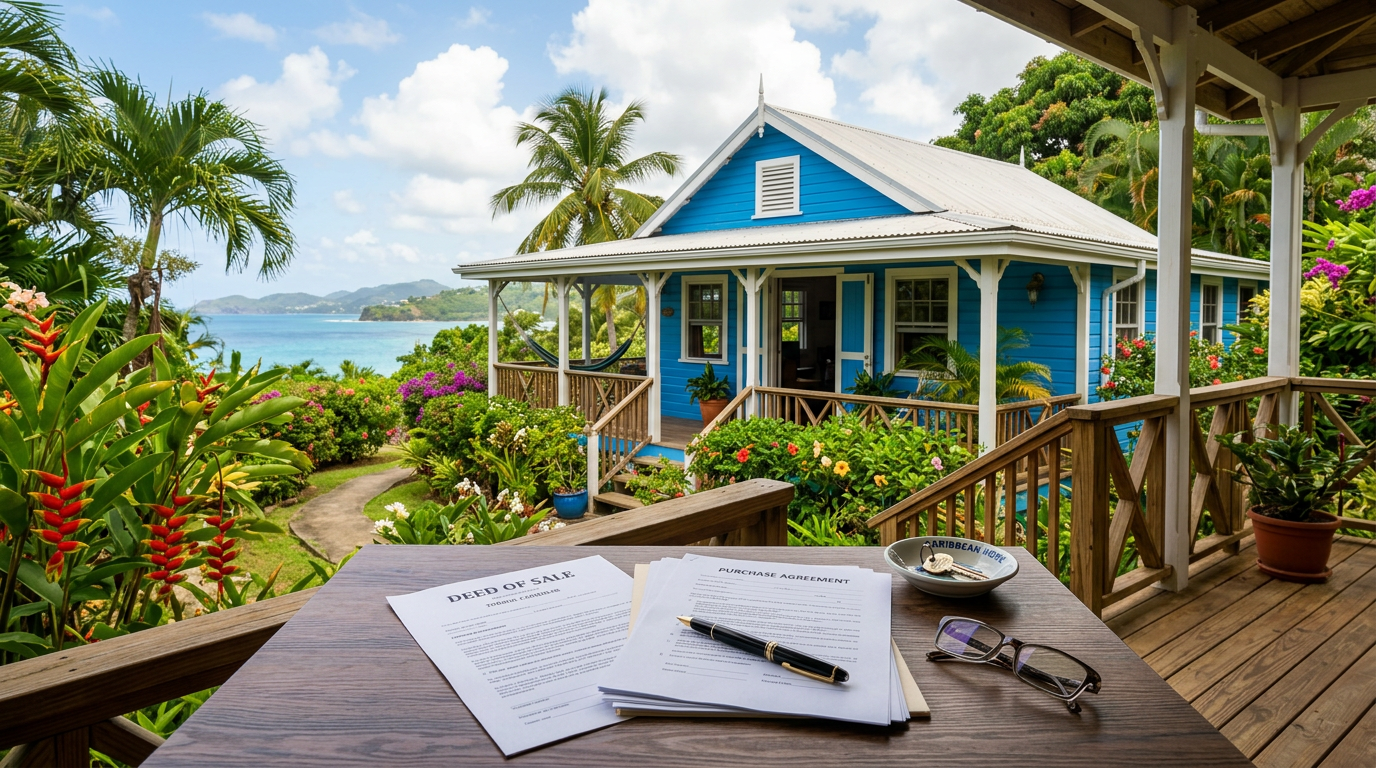
Property tax in Trinidad and Tobago is relatively straightforward and, by international standards, quite low. Whether you're a foreign investor, an expat resident, or a local buyer, understanding how property tax works is essential to your ownership costs and long-term planning. This guide breaks down current rates, calculation methods, exemptions, payment deadlines, and what you need to know as a property owner in Tobago.
What's in This Guide
1. Current Property Tax Rates in Tobago
Property tax in Trinidad and Tobago is levied as a percentage of the Annual Taxable Value (ATV) of the property. The rate depends on the property classification:
| Property Type | Tax Rate | Status |
|---|---|---|
| Residential | 3% of ATV | Actively collected |
| Commercial | 5% of ATV | Legislated; implementation varies |
| Agricultural | 1% of ATV | Legislated; selective collection |
| Industrial | 3–6% of ATV | Legislated; selective collection |
2. How Property Tax Is Calculated
Property tax calculation follows a three-step process:
Step 1: Annual Rental Value (ARV) Assessment
The Commissioner of Valuations assesses what your property could reasonably rent for on an annual basis. This is not what you actually charge tenants, but rather a standardized market rental valuation. For example, a three-bedroom home in Crown Point might be assessed at an ARV of TT$60,000 per year, while a larger property in Lowlands might have an ARV of TT$120,000.
Step 2: Apply Vacancy Deduction
The Board of Inland Revenue applies a standard 10% deduction to account for potential vacancy periods. This deduction is applied to all properties, whether occupied or not.
Formula: ARV × 0.90 = Annual Taxable Value (ATV)
Step 3: Apply Tax Rate
The 3% residential tax rate is then applied to the ATV to determine your annual property tax liability.
Formula: ATV × 0.03 = Annual Property Tax
Worked Examples
Example 1: Modest Residential Property
- Annual Rental Value (ARV): TT$60,000
- Vacancy deduction (10%): TT$6,000
- Annual Taxable Value (ATV): TT$54,000
- Property tax at 3%: TT$1,620 per year (approximately US$240)
Example 2: Larger Property or Villa
- Annual Rental Value (ARV): TT$120,000
- Vacancy deduction (10%): TT$12,000
- Annual Taxable Value (ATV): TT$108,000
- Property tax at 3%: TT$3,240 per year (approximately US$480)
As you can see, even for larger properties, annual property tax remains very modest by global standards.
3. The Good News: What Tobago Doesn't Tax
Trinidad and Tobago's tax environment for property is notably favourable compared to North America, Europe, and most other Caribbean islands. Here's what property owners do not pay in Tobago:
No Capital Gains Tax. When you sell your property at a profit, there is no capital gains tax. You keep 100% of your gain. This is a massive advantage for investors who would otherwise pay 15–28% in countries like the US, Canada, or the UK.
No Inheritance or Estate Tax. Property passes to heirs without any estate or inheritance tax liability. This makes Tobago attractive for estate planning and intergenerational wealth transfer.
No Wealth Tax. There is no annual wealth tax based on the total value of your property portfolio.
No Separate Land Tax. Unlike some jurisdictions that tax land separately from structures, Tobago combines both into the annual property tax rate. There are no hidden additional taxes.
When you compare Tobago's annual property tax burden to markets like the United States (1–2% of property value annually in many states), the United Kingdom (council tax plus stamp duty), or Canada (1–2% annually), Tobago offers exceptional value.
4. Exemptions & Reliefs
Several categories of property may qualify for exemptions or reduced tax liability:
Properties Below Assessment Thresholds. Very small or low-value properties may not be included in active assessments, though this is not a formal exemption — rather, a practical implementation gap.
Owner-Occupied Primary Residences. While not a blanket exemption, first-time homeowner considerations may apply in some cases. Check with the Board of Inland Revenue for current policies.
Agricultural Land. Land actively used for agricultural purposes may qualify for reduced rates (1% instead of 3%). Documentation proving agricultural use is typically required.
Pensioner Reliefs. Depending on current government policy, senior citizens and pensioners may qualify for tax relief or exemptions. Eligibility criteria change periodically, so confirm with the Board of Inland Revenue.
Government and Institutional Property. Government buildings, schools, hospitals, and registered charitable institutions are typically exempt from property tax.
5. Payment & Deadlines
When You Receive Your Assessment
Once your property is valued by the Commissioner of Valuations, the Board of Inland Revenue will issue a formal assessment notice detailing your Annual Taxable Value and annual tax liability. Keep this document — you'll need it for payment records and any future appeals.
Payment Methods
Property tax can be paid directly at Board of Inland Revenue offices located in Scarborough and at other regional offices. Some online payment options may be available depending on your bank; check with your financial institution. Payments should be made to the government's account as specified in your assessment notice.
Payment Deadlines
Property tax is typically due by a specified date each year (often 31st March or 30th June, though this may vary). Your assessment notice will state the exact deadline. It is your responsibility to pay on time, even if you don't receive a reminder.
Penalties for Late Payment
Late payment incurs penalties, usually calculated as a percentage of the outstanding tax (e.g., 10% penalty plus interest at a rate set by the Board). The longer the delay, the higher the total penalty and interest charges.
What Happens If You Don't Pay
Unpaid property tax can result in a lien being placed against your property. This means the government has a legal claim on the property to recover the debt. If you attempt to sell or refinance the property, the lien will block the transaction until the outstanding tax (plus penalties and interest) is paid in full.
6. Foreign Owners & Property Tax
Same rates apply. Foreign property owners pay the exact same property tax rates as Trinidad and Tobago citizens — there is no foreign owner surcharge (unlike some other Caribbean islands that charge additional fees for overseas investors).
No automatic withholding. Property tax is not automatically withheld from rental income or other sources. You are responsible for ensuring payment to the Board of Inland Revenue.
Licence to Purchase compliance. Foreign buyers must keep their property tax current to maintain compliance with the Licence to Purchase agreement. A lien for unpaid property tax could jeopardize your ownership status, so treat it as a priority.
Appointing a local representative. If you live overseas, you can appoint a local attorney, accountant, or property manager to handle tax payments on your behalf. This is a straightforward process and highly recommended for peace of mind.
Currency considerations. Property tax is assessed and paid in Trinidad and Tobago dollars (TT$). The exchange rate fluctuates, so budget accordingly if you're converting from another currency. Current rates typically range from TT$6.50–TT$6.70 per USD$1.
7. Property Tax vs Other Caribbean Islands
How does Tobago's property tax compare to neighbouring islands? Here's a quick regional snapshot:
| Island | Annual Tax Rate | Typical Annual Cost (USD) |
|---|---|---|
| Tobago | 3% of ATV (~US$200–$500/yr typical residential) | Low |
| Barbados | 0.1–0.75% of improved value | Low–Moderate |
| Jamaica | Various rates on unimproved value (0.5–1.5%) | Moderate |
| Cayman Islands | No property tax | None |
| Bahamas | 0.625–1% of market value | Moderate–High |
| US (average state) | 1–2% of market value | High |
| UK (council tax) | Variable; plus stamp duty | High |
Bottom line: Tobago is exceptionally competitive. While the Cayman Islands have zero property tax, Tobago's modest 3% of assessed rental value (typically TT$1,000–TT$5,000 annually) makes it one of the most tax-efficient Caribbean property markets for residential owners. Add in the absence of capital gains tax, and Tobago becomes highly attractive from a tax planning perspective.
8. Frequently Asked Questions
How much property tax will I pay per year in Tobago?
Annual property tax for residential properties typically ranges from TT$1,000–TT$5,000 per year (approximately US$150–US$740), depending on your property's assessed Annual Taxable Value. A modest home with an ARV of TT$60,000 results in roughly TT$1,620 annually; a larger villa with an ARV of TT$120,000 results in TT$3,240 per year. These are among the lowest property tax burdens globally.
Do I pay property tax if I'm renting out my property?
Yes. The property owner (not the tenant) is responsible for paying annual property tax regardless of occupancy status. Whether your property is vacant, owner-occupied, or rented out, you must pay the annual 3% tax on the Annual Taxable Value.
How often is my property revalued for tax purposes?
Properties undergo periodic reassessment by the Commissioner of Valuations, typically every 3–5 years or when property values in an area change significantly. You will receive notification when your property is scheduled for revaluation. Reassessments may result in higher or lower assessed values depending on market conditions.
Can I appeal my property tax assessment?
Yes. If you believe your property has been incorrectly valued, you may lodge a formal objection with the Board of Inland Revenue. Objections must typically be submitted within 30 days of receiving your assessment and must include supporting documentation (comparable sales, recent appraisals, etc.). The Board will review and either confirm, adjust, or set aside the assessment.
Is property tax deductible from rental income tax?
Yes. Property tax is a legitimate business expense and is fully deductible from your rental income when calculating taxable rental earnings. This reduces your overall income tax liability, making the actual net cost of property tax even lower for rental property owners.
Ready to Find Your Tobago Property?
Understanding property tax is just one part of smart real estate ownership. Abraham Realty has been helping buyers and investors navigate Tobago's property market since 1990. Whether you're buying a vacation home, primary residence, or investment property, our team can guide you through the entire process — including closing costs, ongoing tax obligations, and wealth-building strategies.
Browse All Properties Get in TouchRelated Articles
Deepen your knowledge with these related guides:
The Complete Guide to Buying Property in Tobago — covering the legal process, best areas, and step-by-step buying instructions.
Tobago Closing Costs Explained — a detailed breakdown of stamp duty, legal fees, and all ancillary costs.
How to Earn Rental Income from Tobago Property — strategies for short-term and long-term rental success.