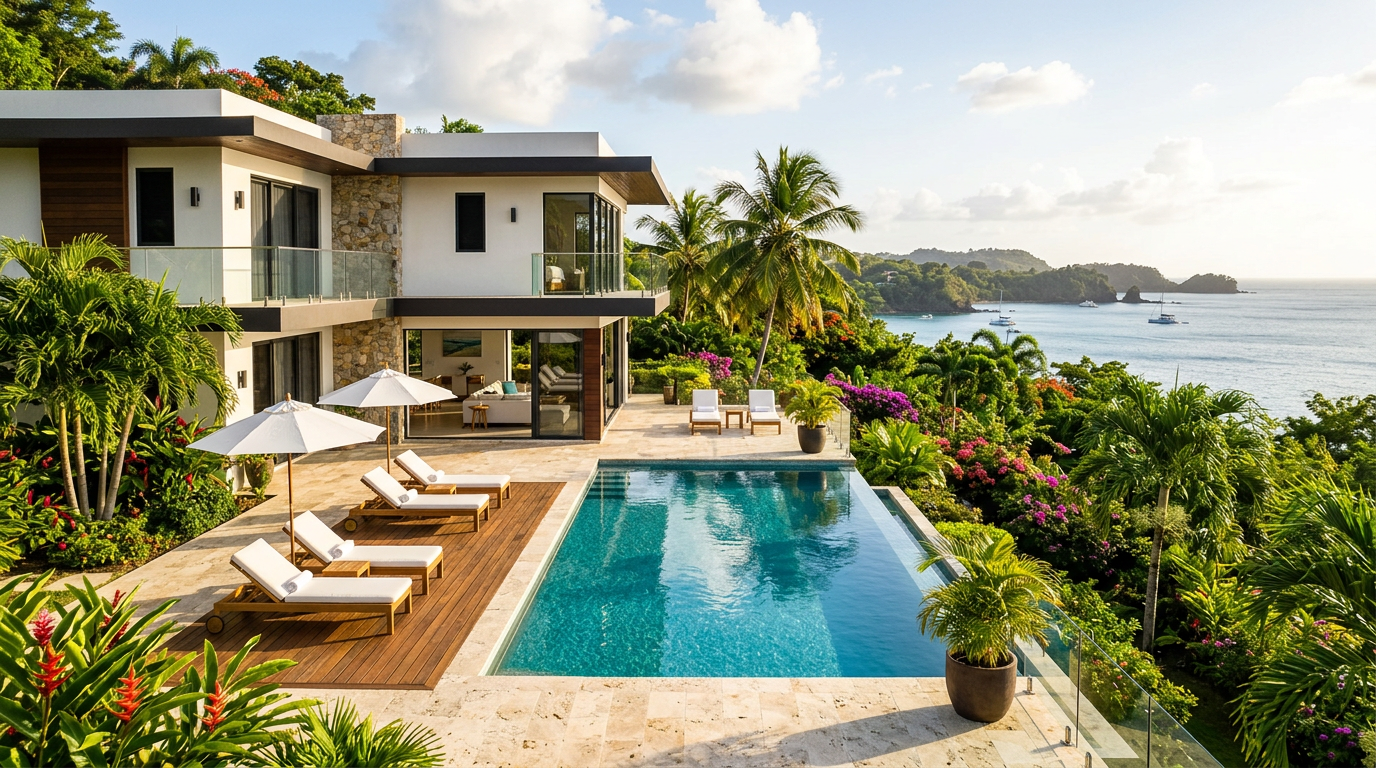
Tobago is one of the Caribbean's most undervalued property markets. But is it right for your investment goals? This comprehensive guide cuts through the marketing speak to give you honest data on rental income potential, capital appreciation, tax advantages, and the very real risks you need to understand before investing your capital in Caribbean real estate.
What's in This Guide
1. Why Invest in Tobago Real Estate?
Tobago's property market offers a rare combination of features that appeal to serious investors: a stable legal framework, tax-efficient returns, no capital gains tax, and entry prices that are 40-60% lower than comparable Caribbean jurisdictions like Barbados or the Cayman Islands.
No capital gains tax. This is the headline advantage. When you sell your Tobago property, you keep 100% of your profit. In contrast, US investors pay 15-20% on long-term capital gains, and Canadian investors face 50% inclusion on gains. For a property that appreciates from US$300,000 to US$450,000, that's a tax-free US$150,000 gain — versus US$22,500-$30,000 in taxes elsewhere.
No inheritance or estate tax. Trinidad and Tobago has no wealth tax, no inheritance tax, and no estate duty. Your heirs receive the property without tax consequences, making Tobago ideal for intergenerational wealth planning.
Growing tourism sector. Tobago has positioned itself as an eco-tourism and beach destination. New direct flights from North America and Europe, recent hotel investments (Hilton Tobago opened in 2023), and expanding ferry service from Trinidad have driven visitor numbers up 35% since 2019. This creates tangible demand for short-term rental properties.
Affordable entry point. While Crown Point residential properties run TT$2.5M-$5M (US$370K-$740K), you can find excellent land investment at TT$400K-$1M (US$59K-$148K). This lower entry cost means you can diversify across multiple properties or test the market before committing significant capital.
English-speaking, stable democracy, common law system. Unlike many emerging markets, Trinidad and Tobago is politically stable with a functioning judiciary and clear property law based on the English common law tradition. Your legal rights as an investor are well-defined and enforceable.
Historical capital appreciation. Over the past 10 years, residential properties in key areas have appreciated 3-5% annually. While not spectacular, this compounds to a 34-63% total return over the decade — plus any rental income collected along the way.
2. Investment Strategy Comparison
Not all Tobago real estate strategies are created equal. Here's how they stack up based on capital requirements, expected returns, effort, and risk:
| Strategy | Entry Cost | Annual Return | Effort Level | Best Area | Risk |
|---|---|---|---|---|---|
| Short-term vacation rental (Airbnb/VRBO) | US$250K-$500K | 8-12% (gross rental yield) | High (or hire manager) | Crown Point, Buccoo, Bon Accord | Medium (occupancy risk) |
| Long-term residential rental | US$200K-$400K | 4-6% (net yield) | Low | Canaan, Store Bay, Scarborough | Low |
| Land banking (buy and hold) | US$50K-$150K | 3-5% (appreciation only) | Very low | North coast, Bon Accord, Canaan | Low-Medium |
| Development (build to sell/rent) | US$300K-$1M+ | 15-25% (if executed well) | Very high (requires management) | Canaan, Bon Accord, Lowlands | High (execution risk) |
| Commercial property | US$400K-$2M+ | 6-10% (net yield) | High (tenant issues) | Crown Point, Scarborough | Medium-High (market dependent) |
| Eco-lodge / boutique hotel | US$500K-$3M+ | 12-18% (high season) | Very high (24/7 operations) | Castara, Speyside, Englishman's Bay | High (seasonal, operational) |
3. Rental Income Deep Dive
For many Tobago investors, the appeal is dual income: rental cash flow while the property appreciates. Let's look at real numbers.
Airbnb Market Performance
Short-term rental data from 2024-2025 shows:
Average daily rate (ADR): US$180-$250 for 1-2 bedroom properties in Crown Point and Buccoo. Luxury villas (3+ bedrooms) command US$300-$600+. Off-season (June-August) rates drop 30-40%.
Occupancy rates: Crown Point averages 41-45% occupancy annually. Buccoo ranges 38-42%. More remote areas like Castara and Speyside see 25-30% occupancy but attract higher nightly rates.
Annual revenue example: A 2-bedroom villa in Crown Point renting at US$220/night with 42% occupancy generates approximately US$19,000 in gross revenue annually (365 days × 42% × $220). After property management fees (20%), maintenance, utilities, and insurance (roughly 35-40% combined), net annual cash flow is US$12,000-$13,000 — roughly 6-7% gross return on a US$200K property investment.
Best Performing Areas for Rentals
Crown Point & Store Bay: Highest occupancy (41-45%), premium nightly rates (US$200-$350), busiest during December-April. Best for properties with 2-3 bedrooms and modern amenities.
Buccoo: Strong performance (38-42% occupancy), younger demographic, party scene (Buccoo Reef, Sunday School), rates US$150-$250. Good for lifestyle properties attracting divers and beach lovers.
Bon Accord & Lowlands: Emerging rental markets with slightly lower occupancy (32-38%) but rising demand. Lower property costs mean better entry-level ROI potential. Premium resort areas (Magdalena Grand, Tobago Plantations) see higher rates.
Mount Irvine & Lowlands: Golf course proximity drives steady occupancy (35-40%). Golf-focused tourists willing to pay premium rates. Average US$200-$280/night.
Seasonal Patterns
Tobago's rental calendar is highly seasonal:
December-April (High Season): North American winter escape season. Occupancy peaks at 60-75% in prime areas. Daily rates at their highest. This 4-month window generates 50-60% of annual revenue.
June-August (Secondary Peak): Summer family vacations. Occupancy 30-45%. Rates drop 25-30%. European tourists and diaspora returning home.
September-November (Low Season): Post-summer lull, hurricane season concern. Occupancy 15-25%. Rates 40-50% below peak. Many properties offer discounts to fill calendars.
This seasonality is critical: if you need consistent monthly cash flow, Tobago rentals may disappoint. If you can absorb seasonal variation, it's manageable.
Management Costs
Self-managing a rental from abroad is possible but challenging. Reliable property managers charge 15-25% of gross rental revenue. They handle guest communication, cleanings, maintenance coordination, and guest issues. On a US$19,000 annual gross revenue, that's US$2,850-$4,750 annually. Hiring a professional manager buys you peace of mind but impacts net returns.
4. Capital Appreciation & Property Growth
Beyond rental income, Tobago property investors benefit from steady appreciation — the "boring" but reliable path to wealth.
Historical Price Growth
Over the past decade (2014-2024), residential properties in developed areas have appreciated at:
Crown Point & Buccoo: 4-6% annually on average. A property purchased for US$300,000 in 2014 is worth roughly US$480,000-$575,000 today. This reflects strong tourism demand and limited supply of oceanfront property.
Bon Accord & Canaan: 3.5-5% annually. Lower starting prices but steady appreciation as these areas develop. Investment corridors where new residential communities are emerging.
Lowlands & Mount Irvine: 3-5% annually. Resort development and golf community investments drive steady demand.
North Coast (Castara, Speyside): 2-3% historically, but expected to accelerate with eco-tourism infrastructure. Land very cheap (TT$300K-$600K per acre) with high upside if tourism develops.
Key Drivers of Future Growth
Airport improvements: Crown Point International Airport expansion continues, with capacity to handle larger aircraft and more flights. Better connectivity drives property demand.
Tourism infrastructure: New hotels (Hilton, expanded resort pipeline), dive sites, restaurants, and attractions keep drawing international visitors and investors.
Underwater fibre optic cable: The ALBA cable (deployed 2024) provides high-speed internet directly to Tobago for the first time, enabling remote work and digital business operations. This is a long-term game-changer for property values.
Improved ferry service: More frequent and reliable ferry service from Trinidad reduces travel friction and opens Tobago to day-trippers and commuters, expanding the addressable market.
Limited land supply: Tobago is only 116 square kilometers. Development-zoned land is finite, creating natural scarcity that supports prices.
5. Tax Advantages for Investors
Tobago's tax framework is exceptionally investor-friendly — one of the strongest advantages versus other Caribbean markets or your home country.
No Capital Gains Tax
Trinidad and Tobago does not levy capital gains tax. Whether you hold for 1 year or 20 years, when you sell, you keep 100% of the appreciation. This is unique; most countries tax long-term property appreciation at 15-25%. For a US$300K property appreciating to US$450K, you pocket the full US$150K gain.
No Inheritance Tax or Estate Duty
There is no estate tax or inheritance duty in Trinidad and Tobago. Pass your property to your heirs tax-free. This makes Tobago attractive for intergenerational wealth planning.
Minimal Property Tax
Annual property tax in Tobago is negligible — typically US$200-$500 per residential property, based on assessed value. Compare this to 1-2% of property value in many US states, and Tobago is a bargain.
Rental Income Tax
Rental income is taxable as ordinary income. Residents pay corporate/personal income tax (12-37.5% depending on bracket). However, significant deductions are available:
Mortgage interest, property tax, insurance, maintenance, repairs, utilities, property management fees (15-25%), and depreciation are all deductible. A property generating US$20K in gross rental income might only face tax on US$10K-$12K of net income after deductions — reducing effective tax rate to 6-9%.
No Wealth Tax
Trinidad and Tobago has no annual wealth tax or net worth tax. Own property outright without facing annual asset-based levies.
6. Investment Cost Structure
Understanding the full cost of ownership is critical for accurate return calculations.
Purchase Costs (5-10% of purchase price)
When acquiring a property:
Stamp duty (buyer): 0-7% depending on property value (see prior post for tiers). For a US$300K property, expect US$8K-$15K.
Legal fees: 1.5-2.5% of purchase price. On US$300K, that's US$4,500-$7,500.
Valuation & survey: US$1,500-$4,000 combined for residential property.
Total acquisition cost: Budget 5-10% on top of purchase price. For a US$300K property, plan for US$15K-$30K in closing costs.
Annual Holding Costs
Property tax: US$200-$500/year (minimal).
Insurance: US$800-$2,000/year depending on property value and coverage type.
Maintenance & repairs: Budget 1-2% of property value annually. On a US$300K property, that's US$3,000-$6,000/year. In tropical climates, roof repairs, painting, hurricane-proofing, and pest control are ongoing.
Property management (if renting): 15-25% of gross rental revenue, or US$2,000-$4,000/year if on a fixed fee.
Utilities (if furnished rental): US$1,500-$3,000/year.
Total annual carrying cost: US$7,500-$15,500 per year on a US$300K property, or 2.5-5% of property value.
Sample ROI Calculation
Let's model a realistic 3-year scenario:
Property: 2-bed villa in Crown Point, purchase price US$300,000.
Year 1: Acquisition cost US$20K. Gross rental income US$18,000. Management + maintenance US$10,000. Net cash flow: US$8,000. Property appreciates 4% to US$312,000. Total return (cash + appreciation): US$20,000.
Year 2: Gross rental US$18,500. Expenses US$10,500. Net cash flow: US$8,000. Appreciation 4% (US$312K to US$325K). Total return: US$17,000.
Year 3: Gross rental US$19,000. Expenses US$11,000. Net cash flow: US$8,000. Appreciation 4% (US$325K to US$338K). Total return: US$21,000.
3-year total return: US$58,000 (cash flow) + US$38,000 (appreciation) = US$96,000 on a US$300K investment. That's 10.6% annualized return — solid for a conservative Caribbean property play.
7. Risks & Honest Assessment
Investing in Tobago real estate carries real risks. No prudent investor should ignore these.
Liquidity Risk (Critical)
Tobago's property market is small. Unlike the US, where you can sell a home in weeks, Tobago properties can take 6-18 months to sell — and that's if you price competitively. If you need capital urgently, you may face pressure to accept a below-market offer. This is not a liquid investment. Plan on holding for 5+ years minimum.
Currency Risk
The Trinidad and Tobago dollar (TT$) is officially pegged to the US dollar at roughly 6.75 TT$ = 1 USD. However, it is not freely convertible. If you repatriate rental income or sale proceeds to USD, you may face delays or be subject to informal conversion rates. For dollar-based investors, this is manageable; for those in other currencies, there's additional risk.
Occupancy & Seasonal Risk
Short-term rental properties depend on tourism. A global recession, pandemic, or travel disruption devastates occupancy. Tobago saw occupancy rates drop to 10-15% during 2020-2021 lockdowns. If your business model relies on 40% occupancy, a 25% drop halves your cash flow. Stress-test your projections.
Regulatory Risk
Foreign buyer licensing processes could change. Tax laws could evolve. A future government could impose capital gains tax or restrict foreign ownership. These are low-probability scenarios, but they're not zero-probability. The Caribbean has seen policy shifts before.
Infrastructure Risk: Hurricanes & Utilities
While Tobago sits south of the main Atlantic hurricane belt and is rarely hit directly, damage from passing storms is possible. Flood insurance is not routinely available and hurricane-proofing is expensive. In rural areas, electricity can be unreliable and water shortages occur seasonally. Resorts have backup generators; residential properties may not.
Management Risk
On a small island, finding reliable property managers, contractors, and service providers is challenging. Bad management will erode your returns faster than any other factor. Due diligence on your property management partner is essential.
8. Best Areas to Invest in Tobago
Location drives returns. Here's where investors should focus based on their strategy:
Highest Rental Yield: Crown Point
Proximity to airport, restaurants, nightlife, and main beach. Occupancy 41-45%, rates US$180-$350/night. Properties here are pricey (US$300K-$600K for a 2-bed villa) but strong rental demand justifies premium pricing. Best for investors prioritizing cash flow.
Best Capital Growth: Bon Accord & Canaan
Emerging residential corridors with 3-5% annual appreciation, lower entry prices (US$150K-$300K), and new development activity. If you're 10+ year horizon, these "value" areas offer the best long-term capital gains potential. Less rental income but better appreciation.
Luxury Segment: Mount Irvine
Premium golf community, resort lifestyle, high-net-worth demographic. Properties range US$400K-$2M+. Moderate rental returns (4-6%) but strong capital preservation and lifestyle value. Attracts serious investors and retirees.
Long-Term Land Play: North Coast (Castara, Speyside, Englishman's Bay)
Very low entry prices (US$40K-$150K per acre), pristine scenery, emerging eco-tourism infrastructure. Occupancy and daily rates lag Crown Point, but land appreciation potential is highest here as tourism develops. 10-15 year timeline.
Budget Entry: Scarborough & Lambeau
Capital city with practical appeal for long-term rental (local tenants, stable 4-6% yields). Lower property prices (US$80K-$200K) but also lower appreciation. For conservative investors seeking steady income over appreciation.
9. Getting Started: Your Investment Checklist
If you've decided Tobago real estate aligns with your goals, here's how to proceed systematically:
Step 1: Define Your Strategy — Are you optimizing for rental income, capital growth, or both? This shapes where you buy and what property type fits.
Step 2: Set Your Budget — Determine total capital available. Remember to include 10% for closing costs and 12 months of holding costs. A US$300K purchase requires US$330K-$350K in total capital to be safe.
Step 3: Choose Your Area — Based on strategy and budget, select 2-3 target areas. Do not chase the "hot" area; focus on fundamentals (occupancy, appreciation, management ease).
Step 4: Engage Advisors — Hire a local real estate agent familiar with investment properties and an attorney experienced in conveyancing. They're your due diligence partners.
Step 5: Visit Tobago — Do not buy remotely. Plan a 5-7 day visit. Walk neighborhoods, view multiple properties, meet potential property managers, eat at local restaurants. Feel the area. This is non-negotiable.
Step 6: Start Foreign License Process (if applicable) — If foreign, apply for Licence to Purchase as soon as you've identified a target property. This takes 4-8 weeks; start early.
Step 7: Make an Offer & Conduct Due Diligence — Negotiate price, run title searches, get property survey/valuation, and verify utilities/access. This is the 60-90 day window where most issues surface.
Step 8: Arrange Property Management — Before closing, interview and hire your property management company. They'll operate the property and determine real cash flow.
10. Frequently Asked Questions
Is Tobago a good investment for foreigners?
Yes, with realistic expectations. Foreigners face a Licence to Purchase requirement (4-8 weeks), can own up to one acre residential/five acres commercial, and benefit from the same no-capital-gains-tax framework as locals. The process is transparent and well-established. Best suited for investors with 5+ year horizons and ability to absorb seasonal cash flow variation.
What return can I expect on a Tobago property investment?
Expect 3-8% annualized returns depending on strategy. Short-term rental properties can deliver 8-12% gross yields (6-7% net after expenses). Land banking delivers 3-5% appreciation only. Long-term rentals yield 4-6% net. Capital gains add an additional 3-5% annually. Total returns (cash flow + appreciation): 6-10% annualized in solid markets like Crown Point.
How liquid is the Tobago property market?
Low liquidity. Properties typically take 6-18 months to sell. Expect 2-5% price concessions if selling quickly. This is not a liquid investment; it requires a 5-10 year holding horizon. Plan accordingly.
Can I manage my rental property remotely?
Yes. Hire a professional property management company (15-25% of gross rental revenue). They handle guest communication, cleanings, maintenance, and day-to-day operations. This is recommended unless you visit Tobago frequently.
What's the minimum budget to start investing in Tobago?
Land: US$50K-$150K for a developable plot. Rental property: US$250K+ for a modern 1-2 bed property suitable for short-term rental. Long-term rental house: US$150K-$250K. The lower the entry price, the longer the appreciation timeline.
Is now a good time to buy Tobago property?
Yes, with caveats. Tourism is growing (35% visitor increase since 2019), infrastructure is improving (fibre optic cable, airport expansion, ferry service), and prices in emerging areas like Bon Accord remain below peak levels. However, Crown Point properties have appreciated significantly. Best opportunities lie in second-tier areas (Bon Accord, Canaan, north coast) where appreciation potential exceeds that of established Crown Point.
Next Steps: Resources & Further Reading
Want to dig deeper? Read our complementary guides:
The Complete Guide to Buying Property in Tobago — A step-by-step walkthrough of the legal buying process, stamp duty, closing costs, and timeline.
How to Earn Rental Income from Your Tobago Property — Detailed strategies for Airbnb, VRBO, and long-term rental management.
Crown Point Property Investment Guide — Deep dive into Tobago's hottest rental market with specific area recommendations.
Where to Buy in Tobago: Neighborhoods Ranked by Investment Potential — Comparative analysis of all major neighborhoods.
Tobago Closing Costs: Stamp Duty, Legal Fees & Hidden Expenses — Complete breakdown of acquisition costs.
Can Foreigners Buy Property in Tobago? Yes — Here's How — Foreign buyer licensing process explained.
Tobago Eco-Tourism Property Investment: Castara, Speyside & the North Coast — Emerging opportunities in rural Tobago.
Ready to Start Your Tobago Investment?
Abraham Realty has guided hundreds of investors through Tobago real estate since 1990. We'll show you exactly where to invest and help you navigate licensing, legal, and property management.
Browse Investment Properties Get Expert Advice